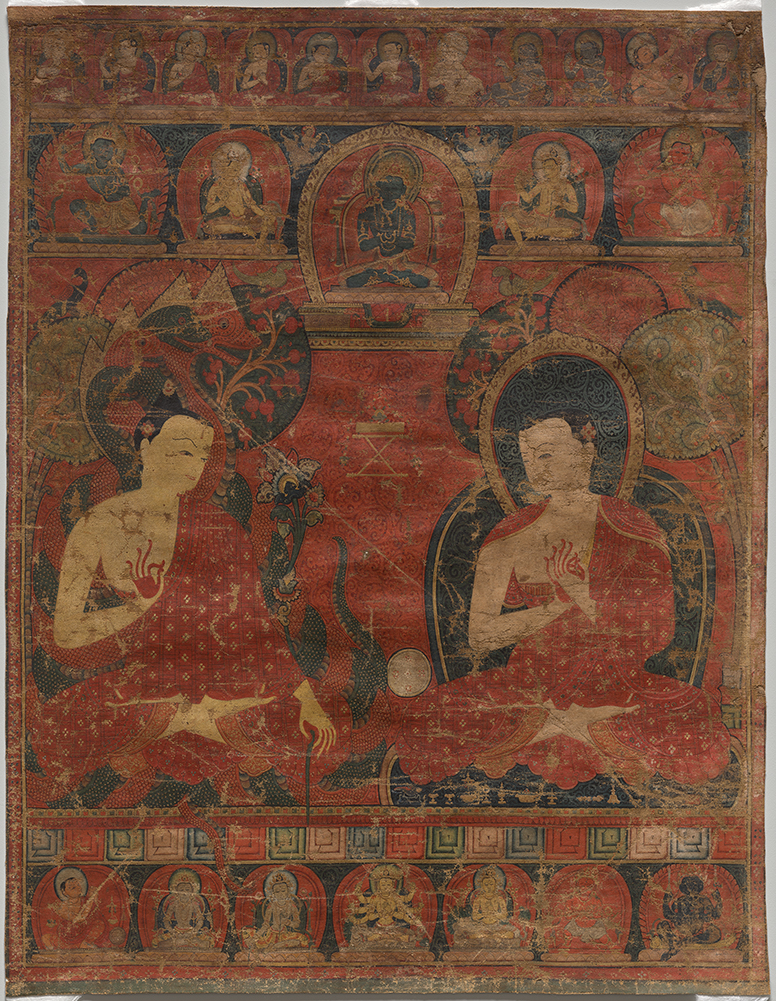
The Buddha famously predicted that the dharma would decline and disappear about a thousand years after his death (and some think he later predicted that it would disappear 500 years after the admission of women to the sangha, though this remains controversial). We can be grateful that he was wrong. The future of the dharma might nonetheless seem under threat today. Modernity has swept much of the globe, bringing with it a commitment to science as the primary arbiter of truth. Like many religious traditions, Buddhism includes doctrines and canonical claims that sit uneasily with the deliverances of modern science. Few today would defend the traditional cosmology of Mount Meru and the four continents. But this doesn’t seem problematic, since many would argue that such cosmological claims are not central to Buddhism. Indeed, the Fourteenth Dalai Lama has said as much.
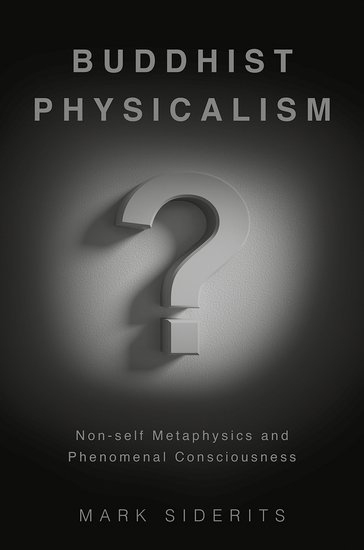
Buddhist Physicalism? Non-self Metaphysics and Phenomenal Consciousness
by Mark Siderits
Oxford University Press, 2025, 240 pp., $99.00, hardcover
More troubling, however, are empirical claims that lie much closer to the heart of Buddhist philosophy and practice. Among these are doctrines of rebirth, the independence of physical and nonphysical aggregates, and understandings of karma as a distinctively ethical form of causation, possibly extending across lives. Each of these appears to run afoul of the broadly materialistic or naturalistic commitments often taken to define modern science. In particular, they seem inconsistent with the view that all that exists is physical, that the mental is not a distinct metaphysical domain, and that all causality is ultimately physical causality. However one understands these claims, the tension between them and core Buddhist doctrines is palpable.
It is to this tension that Mark Siderits’s Buddhist Physicalism? is directed. Siderits, a professor emeritus of philosophy, proposes an alternative response to the pressure modernity places on Buddhism: Rather than rejecting modern science or bracketing it from Buddhist thought and practice, Buddhism can adapt by accepting materialism. He argues that this response is consistent with what he takes to be the broadly naturalistic and reductionist tendencies already present in Buddhist philosophy, and that a modern materialist Buddhism is therefore worthy of serious consideration.
For more than half a century, Siderits has been at the forefront of contemporary Buddhist philosophy. A careful interpreter of Abhidharma, Pramanavada, and Madhyamaka thought, as well as a skilled translator of Buddhist Sanskrit texts, he has been especially influential in bringing Buddhist philosophy into sustained dialogue with analytic philosophy. He has described this method as fusion philosophy, a project that deploys Western philosophical techniques to clarify Buddhist ideas while using Buddhist philosophy to challenge and to reshape contemporary philosophical debates. Buddhist Physicalism? is his most recent salvo in this project.
Despite its brevity, Buddhist Physicalism? is comprehensive in scope, clear in exposition, and compelling as an argument for taking Buddhist materialism seriously. Siderits introduces readers to the fundamentals of Buddhist metaphysics, particularly those of the Abhidharma schools. This discussion will be of value to readers interested in Buddhism who have not studied its philosophical foundations, as well as to experts who will appreciate Siderits’s elegant synoptic presentation. The book will also be of interest to practitioners seeking to reconcile Buddhist practice with a modern worldview, and to readers concerned with how Buddhist philosophy is practiced in the contemporary West.
Rather than rejecting modern science or bracketing it from Buddhist thought and practice, Buddhism can adapt by accepting materialism.
Although Siderits leads readers into demanding debates in both canonical Buddhist literature and contemporary philosophy of mind and cognitive science, he presupposes no prior familiarity with either. Instead, he invites readers into these discussions by foregrounding questions about how a commitment to Buddhism might be harmonized with what we know about the world today, and how a Buddhist analysis of selflessness might inform contemporary thinking about consciousness. Even readers who disagree with his conclusions will find that grappling with them deepens their understanding.
Siderits also introduces the reader to contemporary Western debates about consciousness, the relationship between the mental and the physical, and disputes over reductionism and eliminativism in the philosophy of science. Readers unfamiliar with this literature will find the discussion accessible, while those already acquainted with it will be interested to see where Siderits locates himself within those debates. Together, these discussions ground his claim that the forms of reductionism and eliminativism he identifies in modern science are more congenial to Buddhism than is often assumed, and that a modern Buddhist materialism is therefore worth taking seriously.
This book is extraordinarily clear. Siderits guides readers through complex and technical issues and difficult texts and arguments without ever oversimplifying, writing with precision and care throughout. Any educated reader will find the exposition lucid and engaging; this is certainly not a dry volume addressed only to specialists.
Siderits does not defend Buddhist materialism as a true doctrine, nor does he argue outright that materialism is fully consistent with Buddhism. Instead, he advances the more modest claim that Buddhist materialism is a reasonable option to consider, hence the question mark in the book’s title. His case for this conclusion—and, arguably, for the stronger claim that Buddhism can be materialist—is presented with considerable force. Even readers who reject the conclusion will find that Siderits has shifted the burden of proof onto those who deny that Buddhism can be materialist.
The argument Siderits presents could help shape the future of Buddhist teachings, the ways practitioners understand the role of science and contemporary philosophy in their practice, and the attitudes of contemporary scientists and philosophers toward Buddhism. It may point toward a form of Buddhism no longer in tension with what we know about the world, and toward a greater openness to Buddhism beyond its traditional boundaries. I hope that it does each of these things.
There is an old Tibetan monastic proverb that translates into English as, “Where two scholars agree, there is no scholarship.” So, while I admire and endorse much of what Siderits argues in this book, I will note a few connected areas of disagreement. These reflect different ways of approaching the issues he addresses while accepting his central conclusion, and they illustrate how philosophers who agree about much can still disagree in important ways.
First, in his accounts of both contemporary philosophy of science and Buddhist reductionism, Siderits treats reduction—or even nonreductive supervenience—as a form of eliminativism: Higher-level phenomena are denied reality in favor of the more fundamental phenomena to which they reduce or upon which they supervene. On this view, to say that temperature reduces to mean molecular kinetic energy is to say that molecular motion is real and that talk of temperature is merely a façon de parler—that temperature itself is unreal. Likewise, to claim that financial systems supervene on the physical would be to conclude that there really is no money, only the world described by fundamental physics. Or analyzing a person in terms of the five psychophysical dharma clusters would mean that there really are no persons, only a continuum of evanescent dharmas. This is one plausible way to understand these relationships.
A more promising approach, however, is to accept multiple levels of reality. Explanations offered at higher levels cannot always be restated at more fundamental ones: The law of supply and demand, for example, cannot be translated into the language of physics. Many interpretations of quantum mechanics likewise make essential reference to human observers, who appear only at higher levels of analysis. Remaining realistic about higher-level phenomena is therefore not inconsistent with the materialism or naturalism to which modern science is committed, and this more expansive view may offer a better option for the Buddhist materialist by allowing both conventional truth and ultimate truth to count as genuine kinds of truth, and allowing one to accept the reality of money, temperature, and persons even if they supervene on physical phenomena.
Second, Siderits characterizes Madhyamaka—the “middle way” school founded by the 3rd-century Buddhist philosopher Nagarjuna—as a thorough-going antirealism. This is a point on which both canonical and contemporary scholars disagree, and I find myself on the other side. It is true, as Siderits argues, that Madhyamaka is globally antirealist: Madhyamikas are committed to the emptiness of all phenomena of intrinsic identity. But this does not entail local antirealism. Following exegetes such as the Tibetan monk Tsongkhapa (1357–1419), I take emptiness to mean not unreality but conventional reality: Tables, chairs, electrons, persons, and psychological states are real in the only way anything can be real. Read this way, Madhyamaka offers even stronger motivation for a Buddhist materialism, since such a position need not be committed to the sparse mereological or reductive nihilism that Siderits endorses.
Finally, I would have welcomed a deeper engagement with Carvaka, the classical Indian materialist school with which Buddhism was historically in dialogue. Siderits addresses important Buddhist critiques of Carvaka, which is helpful, but he does not offer a full or sympathetic account of that school’s doctrines or arguments. This omission matters, since some readers may be tempted to view his proposed Buddhist materialism as Carvaka by another name. I don’t believe that it is, but it would be important to show why it is not and then to explain why a Buddhist materialism would be preferable to the materialism India already offers.
These are relatively minor disagreements in the context of a carefully argued and highly successful book. Siderits invites readers into classical and contemporary debates about the fundamental nature of reality and the content of the Buddha’s dharma, developing and defending a striking position with clarity and care. He encourages readers to join a philosophical dialectic that could deepen engagement between Buddhist practice and philosophy and the contemporary world. I recommend accepting that invitation.

Thank you for subscribing to Tricycle! As a nonprofit, we depend on readers like you to keep Buddhist teachings and practices widely available.