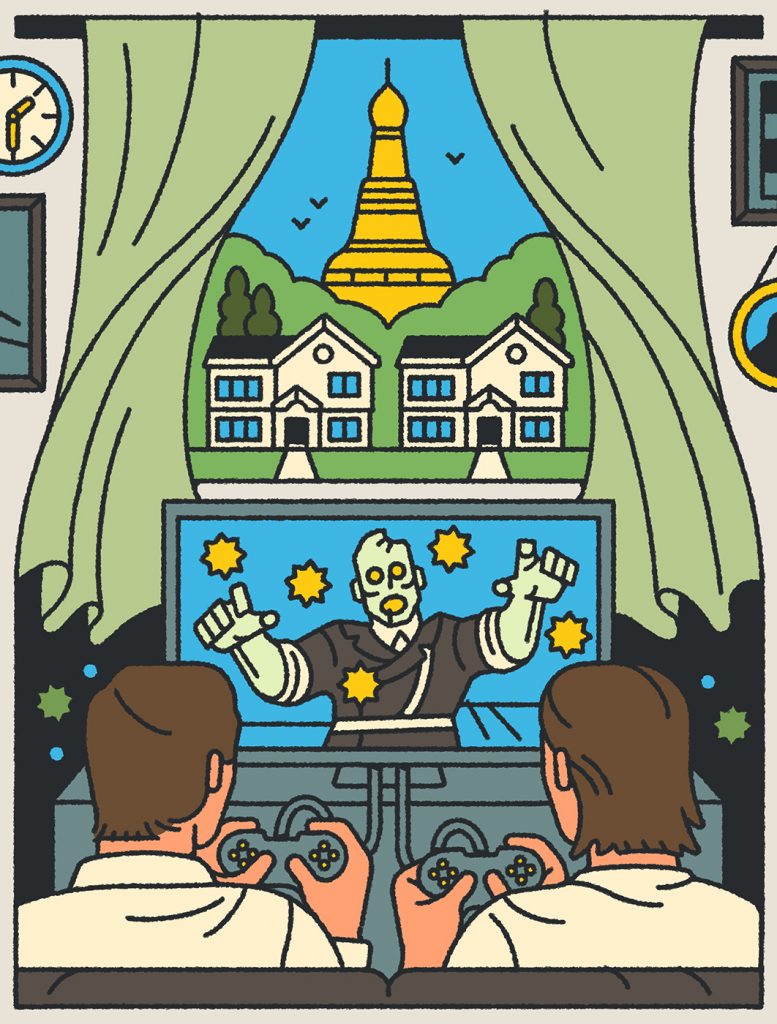
When the undead arrive, I am tidying up.
“If you use your right thumb to build, you can use the left one to shoot,” Nick says. Nick is my brother and very good at Call of Duty. He is teaching me and my friends, the gays and the women, how to kill zombies. He has relegated me to boarding up the entrances. We have taken up shelter in an abandoned movie theater, a kino, as they say in Germany. Nick looks out onto the plaza, where the enemies have begun to spawn.
“Is it the right trigger or the left trigger to shoot?” Michelle asks. Michelle is one of my good friends. She has never played Call of Duty before. But she has brothers who did in high school, like my brother, and my boyfriend Ekin. The four of us are playing together.
A loud boom and a high-pitched ringing. The edges of my screen turn red.
“I think I’m dying,” I say. “Michelle, you killed me.”
“It’s the right trigger,” Ekin says, his screen filled with undead splatter. “The left trigger is a grenade. I’ll come revive you, Simon.”
My quadrant of TV fades from sepia to color as I return from the edge of death. I stand at my post and peer out onto the overcast ruins as my first zombie approaches. He wears a tailored grey uniform, tattered at the edges, a small cross on a chain across his chest. His skin is silvery, and his eyes are piss-yellow. I am told that at one point, when the game first came out, he was portrayed as a Nazi, to more totally vacate him of any possible humanity as you mow him down. But by now the historical specificities of the game have been tastefully abstracted. We are a group of Allied and Axis soldiers, apparently. Ekin is Japanese, and Michelle, maybe American. I am of unknown origin. We have come together to fight an undead plague, a German WW II experiment gone wrong.
The zombie stumbles. He is slow, but my coordination is poor. I feel that eventually, statistically, one of the sixty rounds I fire should find its target. The bullets trace an intricate constellation around him.
“Aim for the head,” Nick says, as he knifes another zombie.
Later that night, I have a stress dream about the violence. I am in an abandoned house trying to protect my family. I saw a quote on the internet once that said family is “a group of people who miss the same imaginary place.” I really liked that. In my dream, I cannot see the invaders, but I can hear them; they sound like cash registers. They spill in from the roof, the windows, and, somehow, the ground. They burst into grey-green clouds of coins and entrails, and I fire at them with shooting stars. There is no way to win, I realize; there is only delayed death. When I wake up, for some reason, I miss that imaginary place.
***
Our favorite Call of Duty map is called “Ascension.” It involves scrambling around a Soviet air base and returning hovercopters to their assigned bases so that one can eventually launch a rocket. The prize, at the base of the launchpad, is a Pack-a-Punch machine, which allows you to upgrade your guns with perks like “Turned,” which converts an enemy zombie to fight for you, or “Thunder Wall,” which can blast a zombie high into the air.
There is a peace that arises from this coordinated teamwork in an imaginary place at the end of the world. But more than a Soviet air base, the imaginary place Call of Duty transports me to is the suburbs. A damp, finished basement with a large sectional and a drop ceiling. The Buddhist temple in the suburb of Manalapan, New Jersey, my family has gone to since I was born. My brothers and I used to hide in the temple’s attic––a long, mothball-scented room—to play video games and hide from aunties. Most often it was Pokémon, because we could bring our Nintendo DS’s with us, and our parents left us unsupervised while they socialized. The ride there was a blur of green lawns, a wash of McMansions with white shutters and topiary. Then, from the horizontal greenness of the suburbs, the gold peak of a Buddhist stupa would emerge, like a faraway peak in a nonplayable part of a video game map. New Jersey, the Garden State, in all its eclecticism, might as well be an imaginary place.
As I begin to creep into my own adulthood, it makes me think, How should I spend my days? What should we consider worth the time of living?
I can’t imagine growing old in a place so different from where I grew up. I’ve gone to Myanmar once with my parents. What was my father’s life like for forty-five years in Mandalay, before he came here? He has a master’s degree in physics. I know he used to teach and help run his parents’ convenience store. But I’ve asked him for details sometimes, and he will say, Oh, you know, teaching, some business, hanging out. My mom is similar; she has a degree in chemistry. She’ll say she would go shopping, meet up with friends, lounge around at home. They met because my father was my mom’s typist for her thesis. What I’m trying to reconstruct, I realize, is a semblance of their lives in the total obliteration of it under parenthood.
At the temple, I glean an imaginary version of the world they used to live in––Yangon, where my mom is from, where people sit on their front porches for hours to talk and eat sunflower seeds, where the neighbors bring mangoes from their trees, where they take showers off your rain gutters for fun, or Mandalay, where the streets turn to mud when it rains, where Google Maps doesn’t work, where they got TVs only in the 1970s––except in New Jersey, where the lawns are like moats, where they have to drive to the next town over to get a respectable mango, and the night outside the windows is so total and dark that you might as well live alone. My parents’ real gift to me is raising me here, when I can somehow weather this isolation without too much scarring.
But they don’t really want to go back. “How lucky we are to be here,” they’ve told me, multiple times, when they see social media about the government crackdowns in Myanmar. “We can do whatever we want here, in peace, with enough food and shelter. Isn’t that what heaven is?”
***
I have been worried about my parents lately. They seem listless, now that my brothers and I no longer live at home. My father works for the government of New Jersey. He leaves at six in the morning to beat the traffic out of the suburbs and gets back at two. When he gets home, he checks the mail, places it next to yesterday’s mail, changes into pajamas, and sits on the couch. He has taken to watching YouTube Shorts on the flatscreen TV upstairs, using the remote to replace the normal flick of a thumb. My mom used to work as a sushi chef for a conglomerate called AFC (Advanced Fresh Concepts Franchise), which would station her at locations in corporate dining halls, supermarkets, and malls, but now she is a full-time caretaker for my grandmother. When she’s not rearranging the house, she watches livestreams on Facebook where they sell Burmese clothes and jewelry.
When my mom was the age I am now, 30, and my father was 45, they got married, had me, and moved to the United States from Myanmar. I turned 30 last year, and the incomprehensibility of having a child and moving to a new country where I do not know the language has only really begun to weigh on me. My brothers and I lacked for little materially or emotionally growing up, even if our parents’ marriage and employment situations weren’t always so felicitous. I remember visiting my friends’ houses, which always felt austere and cold in comparison, places where their parents abandoned them to babysitters, took vacations without them, or went on “date nights,” and I realized that my parents never did any of that. They dedicated their entire lives to raising us, likely at the expense of having any semblance of a life of their own.
I am only now starting to appreciate the extent of their dedication. I’m also beginning to observe their transition from the total art of child-rearing to the openness of their lives afterward. I watch them absorb social media, take walks, and hang out. And as I begin to creep into my own adulthood, it makes me think, How should I spend my days? What should we consider worth the time of living?
***

Back in the Soviet air base, we lift into the air. Nick tells us that this level has an “Easter egg,” a little cut-scene that we can unlock. In round eight, as we ride the third and final hovercopter back to its base, we look down at the concrete bathed in apocalyptic twilight. Blaring red alarms and mysterious contamination signs. We pull a lever and watch as the last rocket takes off in a cloud of smoke. Nick says now to shoot at it, and as the ship rises into the air, departing from the surface and piercing the clouds, our collective shooting detonates it. Debris rains down to the surface. This is apparently why the level is called “Ascension.”
***
Most mornings, my father will wake up at 4 a.m. to meditate before work, and, occasionally, he will do so again in the evenings, after dinner. Since retirement, my mom has also become heavily involved in organizing meditation retreats, and when she’s not dealing with the logistics or sewing butt cushions, she will also hop into nightly Zoom meditations. They organize retreats and festivals; they’re always on Facebook Messenger, figuring out the next trip. They used to beg us for twenty minutes on Sunday mornings, twenty minutes in front of the shrine, to just sit and do nothing and meditate. It used to feel like the longest twenty minutes of my life.
But now I am an adult with stress. And at first, I came back to meditation the way my peers who didn’t grow up with Buddhism did. I downloaded Headspace, an app with such a sharp, millennial aesthetic that I didn’t even think to associate it with the meditation of my childhood. I tried Calm, with its pictures of beaches and mountains and guided meditations. I enjoyed how secularized they were, stripped of talk of enlightenments, karma, heaven, and hell. I just wanted something that helped me feel more relaxed before I went back into my workday, much the way I treated video games. Like many in my generation, I had come to distrust institutionalized religion, and focusing on the practical aspects of meditation felt safe, concrete.
Then I went to a jhana meditation retreat with my mom; or, rather, she signed me and my brothers up, and I realized that meditation could rival the out-of-body experiences I sought in clubs and drugs. For the first time in my life, Buddhism was more interesting than video games. And, for the first time, we could share an interest as adults, rather than as parents and children.
***
I learned that the quote about family as a group of people that miss the same imaginary place comes from a 2004 rom-com called Garden State. It features Zach Braff as a “television bit part actor” named Andrew Largeman, who returns to the New Jersey suburbs to attend his mother’s funeral but finds this place that was once his home utterly alien. He meets the quirky amateur musician Sam (Natalie Portman), and they quickly fall in love.
I haven’t seen the movie, but I looked up the conversation. “You know that point in your life when you realize the house you grew up in isn’t really your home anymore?” Andrew asks Sam toward the end of the movie. “All of a sudden, even though you have someplace where you put your shit, that idea of home is gone.”
“I still feel at home in my house,” Sam says.
Andrew says that one day she’ll move out and it’ll just be gone. And she’ll feel like she can never get it back.
“It’s like you feel homesick for a place that doesn’t even exist,” he continues. “Maybe it’s like this rite of passage, you know. You won’t ever have this feeling again until you create a new idea of home for yourself, you know, for your kids, for the family you start, it’s like a cycle or something. I don’t know, but I miss the idea of it, you know. Maybe that’s all family really is. A group of people that miss the same imaginary place.”
“Maybe,” Sam says, and rests her head on his shoulder.
***
Recently, I decided to try a new form of meditation called TM, or Transcendental Meditation. My friend Alex told me about it after I told her about my jhana retreat. TM is a Vedic meditation practice from India that was popularized in the West in the 1960s and ’70s by a man named Maharishi Mahesh Yogi. When I looked on the website, I saw endorsements from Jerry Seinfeld and David Lynch.
I was skeptical about the $400 initiation fee and the celebrity endorsements. Was it a cult? But on the heels of a jhana retreat with my mom, I was curious to know more about other strains of meditation, even if they strayed from the Buddhism that I was used to.
I signed up because I trust Alex. I scootered to the Brooklyn TM center on Atlantic Avenue. The instructor, frazzled and white, was reassuring. His name was Rick. He asked me to bring two pieces of fruit––preferably nonsour––a white cloth, and to have a light lunch. When I arrived, he took me to a small, grey-tiled room in the back of the town house and lit incense, offering fruit and the cloth to an image of Maharishi, and a few prayers. He insisted that I did not have to participate but just witness, as if to calm the typical religion-skeptic of my generation that they were not being indoctrinated. Little did he know I had sat through hours of prayer.
My mom had rediscovered meditation in the time that we had moved away, gone to college, moved to New York, moved back. This was what we had made space for by moving away.
Rick turned toward me, away from the altar, and began to chant a word, over and over. I was being given a mantra, he said, and I was not to share it with anyone else. He asked me to repeat the word, first aloud and then just in my head. I sat down on a chair and repeated the mantra to myself. Zombies, let’s say I said to myself, even though my mantra is not zombies. Zombies, zombies, zombies, zombies.
It should be easy, he stressed, there should be no effort; if it was easy, that meant I was doing it right. My mind began to drift, my breathing slowed. The mantra sped up and slowed down, the word itself seemed to warp, the syllables becoming elastic. Zombieeeeeees. Zooooooombies. Zombieeessssssss. For a brief moment, as it sometimes would in future sessions, the mantra seemed to disappear entirely, becoming just a wave of exertion in my mind.
Trying TM felt both familiar and strange. It was as if I had invited my mom to lead a retreat in Brooklyn, or I had invited Rick to the temple back in the suburbs. I wondered what my mom would say if she saw me there. After so many years of avoiding meditation, I had somehow sought this out myself. Maybe I had no idea what their new life was like, because I needed to get out of the way for them to find it.
***
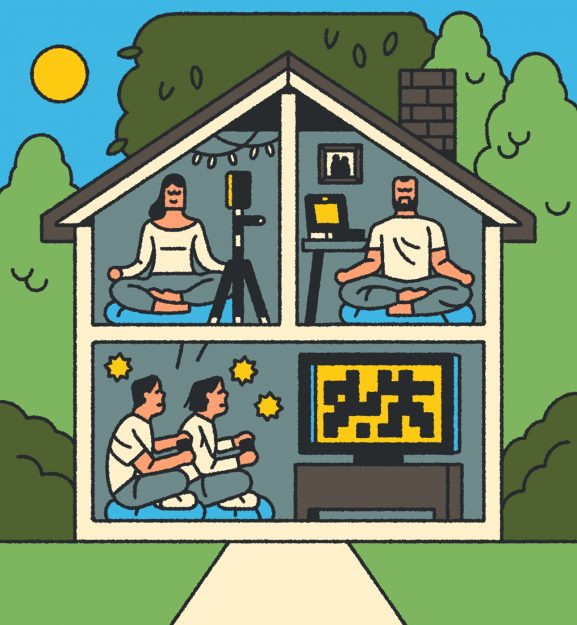
“Can you help me set up this tripod?” my mom yelled.
I had just come home to visit for a weekend from the city. We had eaten dinner, and my brothers and I were sprawled out on the couch downstairs, considering which video game to play.
“Hello?” she yelled again.
I put down my phone and went up. I found her sitting on a pile of cushions, trying to fit her phone into a low tripod. When I asked her why she needed to film herself meditating, she told me that it was for her organization’s new procedure. During the pandemic, when great swaths of life moved to Zoom, so did my mom’s meditation group. Each Zoom session had a monitor who watched everyone’s screens to make sure no one fell asleep or moved too gratuitously.
I was impressed. It was a pretty good use of Zoom. When I looked at her phone, at the grid of other meditators, I saw other little mountains of cushions, other middle-aged Burmese people. The tripod was silver and white; it looked like she’d gotten it from Temu. My mom pointed out an old high school friend she had brought into the group, who was tuning in from Yangon, and another tuning in from Daly City, California, and another from Dallas, Texas, from all over the Burmese diaspora.
My mom had rediscovered meditation in the time that we had moved away, gone to college, moved to New York, moved back. This was what we had made space for by moving away. The Zoom group was a rudimentary approximation of her social network in Burma, reconstituted over Facebook and Zoom. She pointed to another friend she hadn’t spoken to in over twenty years, now reunited. It made me feel warmly toward aging, that connections could be reunited so many years later.
I asked her if she ever meditated with my father, and she laughed.
“He has his own group,” my mom gestured to a closed door, where my father was apparently already in his own Zoom.
I went back downstairs. Nick and Duke had already set up the PS4 for a round of “Ascension.” They looked at me expectantly, pointing to the controller on the couch cushion. For a brief moment, I imagined all of us in the house, us downstairs, my parents upstairs, sucking on our various adult lollipops. I imagined the world of the game extending into the living room, a bizarre mixture of the suburbs, Myanmar, and Call of Duty, an imaginary place both comfortable and horrifying. As the game began, I chanced a look at my teammates’ faces, their jaws slack, their pupils dilated. For a moment, all the other times I have been obsessed with video games, attics full of Pokémon, were a palimpsest on my vision, as if those memories could extend and contract like the bellows of an accordion.
Inevitably, I die. The screen turns sepia. Nick and Duke are too occupied to get to me, and I tell them, it’s OK, I’m happy to be here. I lie on the ground. I look up to see the invisible barrier that marks the playable part of “Ascension” from the nonplayable. The devastation outside the city limits is romantic. Smoke streaks a permanently grey-green sky. A fire tornado turns listlessly. Upstairs, I hear my mom’s tripod collapse again, and make a note to go up and check.

Thank you for subscribing to Tricycle! As a nonprofit, we depend on readers like you to keep Buddhist teachings and practices widely available.