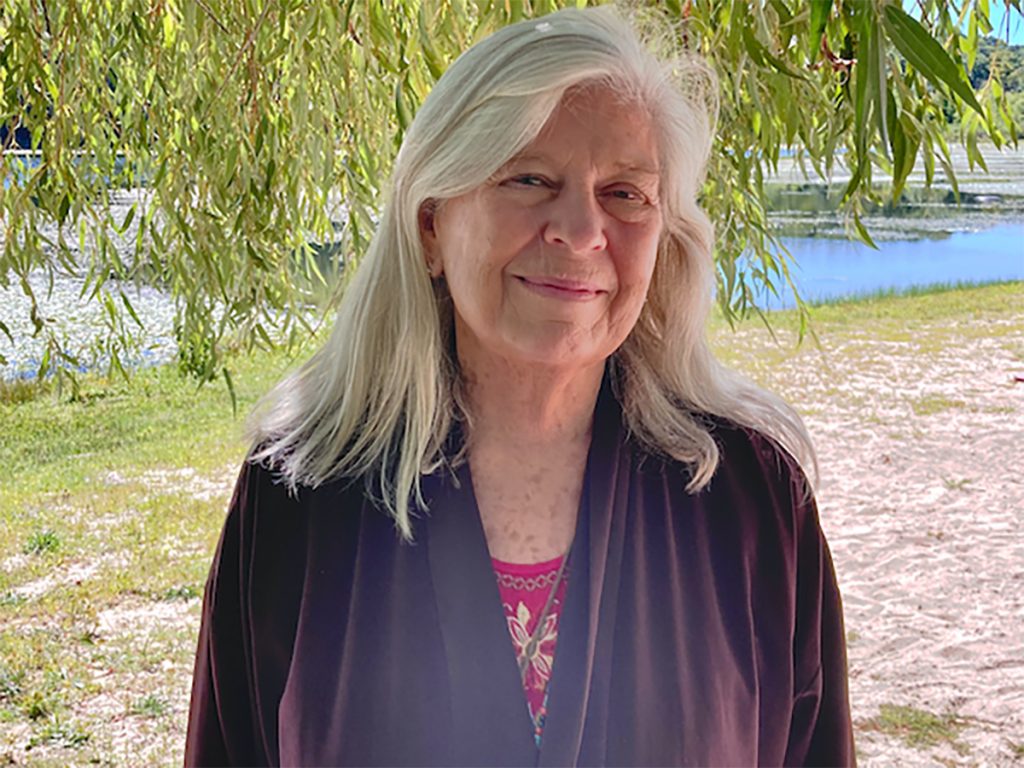
What is the subject of your upcoming Dharma Talk with Tricycle? In May, I went on a pilgrimage with monastics and friends from the Plum Village community to Shikoku Island in Japan. We practiced at sixteen of the eighty-eight temples that are a part of the Shikoku Henro. These temples are connected with Kukai (Kobe Daishi), founder of Shingon Buddhism. There is a model for pilgrims that includes setting our intentions, entering sacred space, purifying by washing of hands and lips, offering three sticks of incense, lighting a small candle, offering a prayer for the world, chanting the Heart Sutra, and the return, bowing as we leave the temple space. At each temple, we engaged in all of these simple and powerful practices of devotion twice. My talk offers a glimpse of this model for the pilgrim’s journey. It’s a reminder that we are all pilgrims. We are right on holy ground, right here and right now. We can bow to each step, and step into this moment in solidity and freedom.
What’s your favorite non-Buddhist book? Hard one. A Wrinkle in Time, Madeleine L’Engle, though this is a Buddhist book. And America’s Racial Karma by my late husband, Larry Ward. My favorite Buddhist book is his poetry, Morning Night.
What’s the most important lesson you learned from your teacher? When Thay read the Anapanasati (“Mindfulness of the Breath”) Sutta, he said that he was the “luckiest person on earth” because he learned how to be with suffering. When I heard him say this, I thought, “Huh,” and I knew to pay attention to this sutta. I made a deep commitment to study and practice the teachings. Thay used to invite us to “enjoy our breathing,” and he would then offer the sweetest smile. I kept practicing, as I wanted to have this experience. One day, I, too, felt the joy of breathing, and that has never left me. I, too, know how to practice to be the happiest being alive.
You use the term “selectively watering our seeds.” What is this, and how do we do it? This is a core teaching from Thich Nhat Hanh inspired by the Yogacara tradition. Every retreat, he offered these teachings. My version:
In my practice, I integrate the four right efforts, or, as Thay referred to these, the four right energies. We look to see what is blooming in the garden of our heart-mind that is wholesome. We name these energies, and we water these seeds so they can continue to bloom. Next, we explore what potentialities of wholesome seeds we have in our store consciousness that might support our heart-mind in this moment. We name these wholesome energies and explore in our meditation how we can support their rising into the living room of our consciousness. Next, we look to see the unwholesome seeds that we have managed to not water, and we strengthen our commitment to practice in such a way that we bring more beauty into the world. Then, after we have cultivated this light, strength, and wisdom, we bring our attention to our living-room consciousness to name what unwholesome seeds are currently in bloom. We look to see how we have been watering these seeds, and we simply stop this nourishment by continuing to water the wholesome seeds, the good, true, and beautiful aspects that bring refreshment and healing to our own consciousness and to our world. We don’t deny, repress, or bypass the less wholesome seeds. We feed the wholesome.
How do we engage with society and avoid burnout? Thay taught and modeled many ways to be engaged in social action and to avoid burnout. He shared that when he first came to the United States, he was overwhelmed by the level of violence in our society as well as the impact of alcoholic consumption. He said, “Oh, there is so much suffering. I had to go and find a playground every afternoon.” I learned self-care in this way, and that I had to monitor my intake of suffering in such a way that I could truly serve others from an open heart. An open heart requires nourishment and rest. Rest as a radical action and a revolutionary action was built into Thich Nhat Hanh’s Order of Interbeing. We are encouraged to have a weekly lazy day and to care for our good hearts and to rest. I continue to develop this skill set to be as lazy as possible.
In August, watch Peggy Rowe Ward’s Dharma Talk “Crossing the Threshold” at tricycle.org/dharmatalks.

Thank you for subscribing to Tricycle! As a nonprofit, we depend on readers like you to keep Buddhist teachings and practices widely available.